
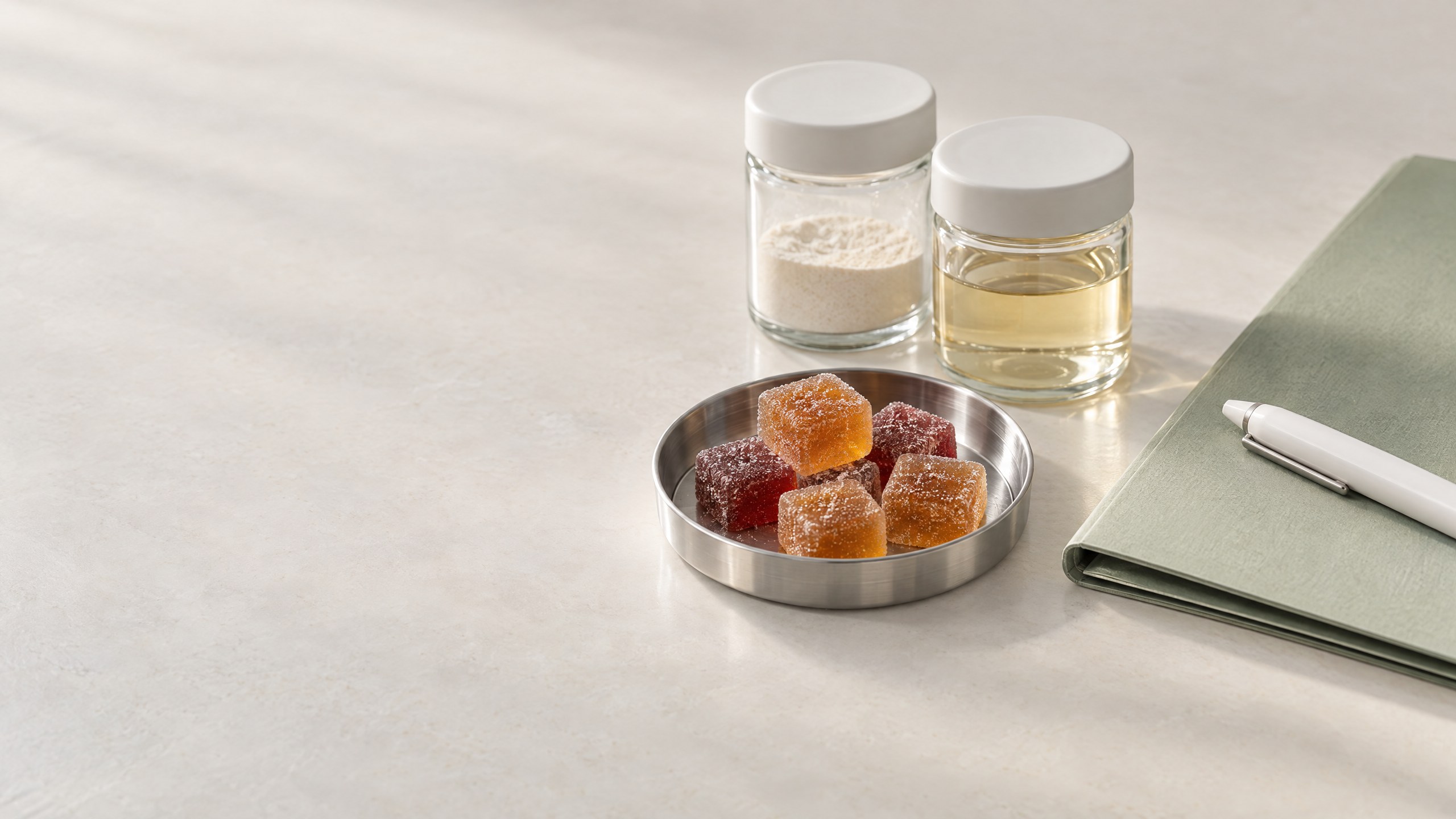
Pectin-Based CBD Gummies: What Brands Should Verify Before Making Ingredient Claims
A pectin-based CBD gummy can fit a brand’s preferred formulation direction. But choosing the gummy base does not settle every statement that may appear on the package. Vegan positioning, allergen-related language, and organic claims require different evidence.
For businesses choosing a CBD gummy manufacturer, the practical question is what supports the exact claim proposed for the finished product. That discussion should happen during formula development, before a designer adds badges or wording to the label.
Sawyer Labs describes its CBD gummies as using a vegan pectin base without animal gelatin, with organic tapioca syrup and all-natural fruit concentrates. Those published capabilities are a starting point for your project conversation—not a reason to assume additional certifications or free-from guarantees. 1
Define the wording before requesting the formula
Write down the statements your brand would like to use. “Pectin-based,” “vegan,” and “contains an organic ingredient” do not describe the same characteristic. A retailer’s certification requirement may also differ from your own preferred wording. Separate essential ingredient restrictions from optional marketing ideas. If a particular claim is central to the product, tell the manufacturing team early and ask what documentation or review would be needed. If it is optional, leave room to adjust the wording to the evidence available. Avoid using “clean” as the whole brief. Specify which ingredients or attributes you mean so the team can evaluate a concrete request.
Review the complete formula for vegan positioning
A pectin base addresses one component of the gummy. For a finished-product vegan claim, ask about the full formulation, including flavors, colors, coatings, carriers, and other added ingredients. Discuss whether any relevant processing materials also need review under the standard your brand intends to follow. Ask what information supports the ingredient-source assessment. Do not treat “no gelatin” as interchangeable with third-party vegan certification. If a certification mark is part of the plan, confirm the applicable scheme and authorization before including it in artwork.
Sawyer Labs supports custom formulation review. Its article on reviewing the full CBD gummy formula explains why ingredient choices must work together with gummy size, flavor, and production requirements. 2 For a custom project, confirm that the agreed ingredient requirements apply to the final revision, not only the initial concept.
Keep vegan and allergen-related claims separate
A vegan product is not automatically free of major food allergens. Plant-derived ingredients such as soy, wheat, peanuts, and sesame can raise allergen questions. The FDA’s food-allergy guidance identifies these among the major allergens that require attention in food labeling and manufacturing. 4 Discuss both the ingredients intentionally used and the possibility of cross-contact. Cross-contact is the unintended introduction of an allergen into a product. Ask how ingredient handling, shared equipment, and packaging operations are assessed for your specific project; do not infer facility controls from a vegan description. 4
If you want to make a free-from claim, identify the particular allergen rather than using an undefined blanket statement. Ask qualified reviewers what evidence and wording are appropriate. FDA guidance also states that advisory labeling should not substitute for good manufacturing practices and must be truthful and not misleading. 4
Distinguish an organic ingredient from an organic finished product
Sawyer Labs’ page identifies organic tapioca syrup as an ingredient. That statement does not establish that a finished CBD gummy is certified organic or entitled to display the USDA organic seal. 1 USDA guidance distinguishes specific organic ingredient listings from finished-product organic labeling categories. The permitted wording depends on the product’s composition and applicable certification requirements. Review the actual formula and proposed label with an appropriate certifier or qualified adviser before making a claim. 5
Keep supplier evidence for an organic ingredient separate from evidence about the finished product. Do not turn a sourcing statement into a front-label certification badge because the two sound similar.
Match each document to the claim it supports
Build the documentation request around the proposed wording. Ingredient specifications or supplier statements may address composition or source. A certificate has a defined scope. A laboratory report describes the sample and analyses identified on that report. None should be assumed to answer every ingredient question.
Sawyer Labs’ article on ingredient COAs and finished-product testing documentation discusses incoming ingredient documentation and finished-product testing. A Certificate of Analysis, or COA, is useful within its scope, but cannabinoid potency or contaminant results do not by themselves establish vegan status or organic certification. 3
Ask which documents are available for your project and which questions need additional assessment. Where supplier information is proprietary, discuss what sufficient supporting information can be provided rather than assuming unrestricted access to every record.
Keep ingredient requirements connected to production
Record the approved formula revision and the evidence supporting each proposed claim. Define who reviews substitutions or later changes to a flavor, coating, or other ingredient. Even when the product name stays the same, the supporting documentation may need another review. Sawyer Labs offers private label development, white label formulas, and bulk programs. Confirm which route fits your ingredient requirements through its CBD gummy manufacturing options. An existing formula still needs assessment against your proposed claims; a custom project needs a clearly agreed development scope. 1
Before approving label artwork, connect the wording to the actual product specification. Ingredient preferences should guide the development brief, not become unsupported assumptions at the printing stage.
Frequently asked questions
Does a pectin base prove that a CBD gummy is vegan-certified?
No. Review the complete formula, and confirm any certification separately. A base ingredient or manufacturer description is not authorization to use a certification mark.
Does organic tapioca syrup make the whole gummy organic?
Not automatically. USDA distinguishes ingredient listings from finished-product claims. Obtain review of the actual formulation, certification status, and proposed wording. 5
Do accurate ingredient claims make CBD gummies lawful to sell?
No. The FDA’s published position excludes CBD from the dietary supplement definition and prohibits introducing food with added CBD into interstate commerce. Obtain qualified review of current federal and applicable state requirements before commercialization. 6
Discuss your CBD gummy ingredient requirements with Sawyer Labs
A useful manufacturing brief pairs each ingredient requirement with the claim your brand hopes to make. Bring your restrictions, proposed wording, and any retailer documentation requirements so the team can discuss feasibility and scope.
Contact Sawyer Labs about pectin-based CBD gummy manufacturing to explore the formulation and manufacturing program suited to your project
References
Sources reviewed November 11, 2026: Sawyer Labs’ current gummy page 1, its formulation and testing articles 2 3, FDA allergen guidance 4, USDA organic-labeling guidance 5, and FDA CBD guidance 6.
